
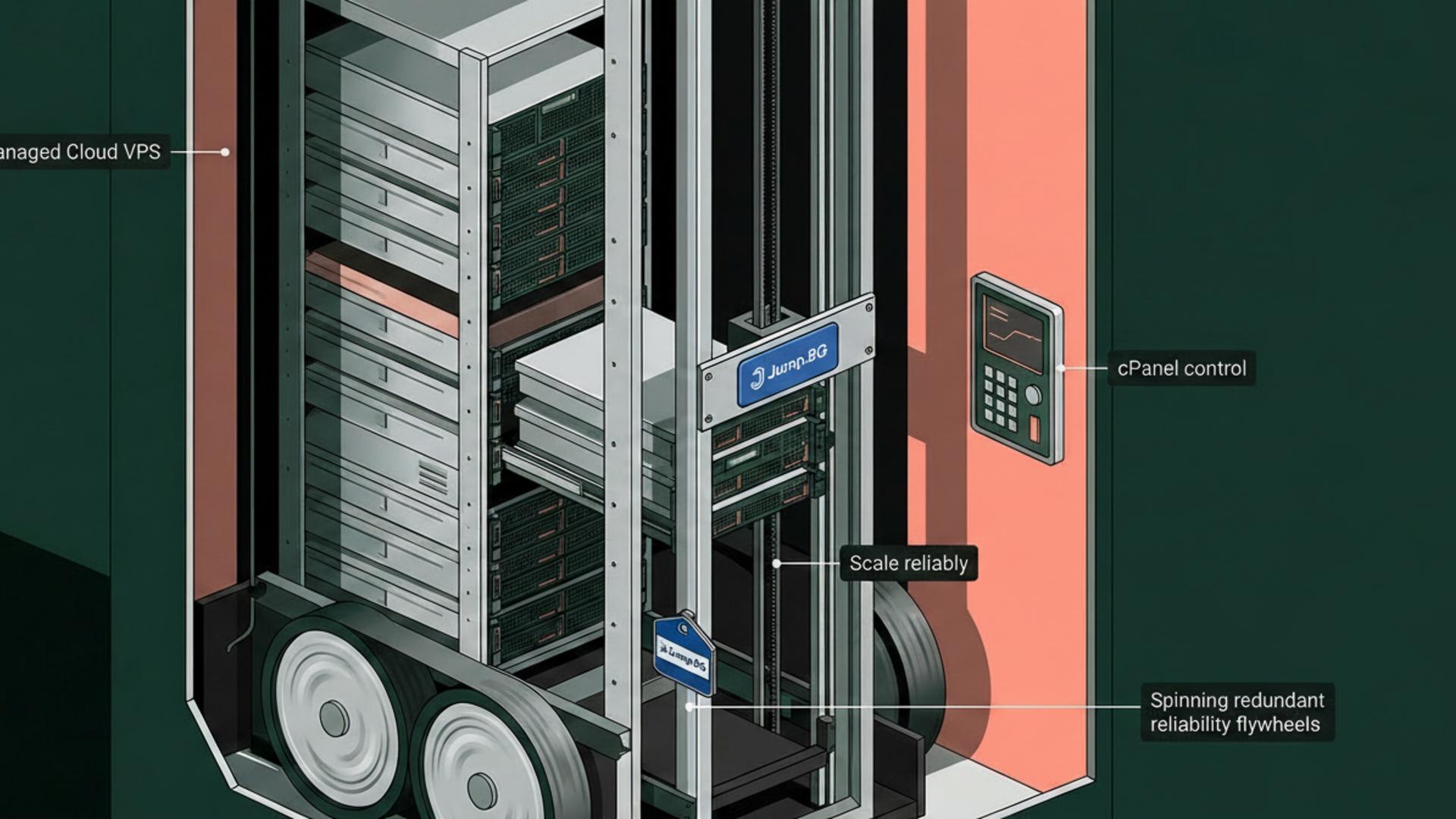
Jump.BG positions itself as a Bulgarian hosting provider with a practical focus on managed cloud infrastructure, rather than a one-size-fits-all self-service platform. Its managed Cloud VPS offering combines virtual server resources with cPanel, automated backups, a dedicated IP address, and ongoing system administration. That combination is particularly relevant for businesses that need more control than shared hosting provides but do not want the operational burden of maintaining a server independently.
This review looks at Jump.BG through the lens of day-to-day usability, scalability, administration, and reliability. The goal is not to treat managed hosting as a universal answer, because infrastructure requirements vary by project. Instead, it considers where Jump.BG's approach is especially useful for understanding what prospective customers should account for before choosing a plan and why its managed model can be a strong fit for growing websites and web applications.
The evaluation focuses on the areas that most directly affect the ownership experience: the Cloud VPS environment, cPanel administration, available support for server operations, the ability to scale resources, and the technical foundations that support stable performance.
The clearest advantage of Jump.BG is the extent to which it reduces the operational gap between traditional hosting and self-managed virtual servers. Instead of handing customers a server and leaving configuration, maintenance, monitoring, and control panel setup entirely to them, the managed Cloud VPS service includes system administration and cPanel setup. For teams without a dedicated infrastructure specialist, this can turn a technically demanding service into a more manageable business tool.
Jump.BG also builds its Cloud VPS offering around distributed NVMe storage with triple data replication. That architecture is meaningful because storage performance and data resilience are fundamental to how a server behaves under routine demand. It is not a substitute for sensible application design or an independent backup strategy, but it provides a solid infrastructure layer for businesses that prioritize responsive websites and dependable access to critical files.
The managed model is most valuable when the priority is having qualified support around the server environment. The tradeoff is that highly specialized teams with unusual software stacks or a strict preference for complete root-level autonomy should confirm the operational boundaries and compatibility requirements before committing. For many growing businesses, however, that structure is a benefit rather than a limitation.
A managed Cloud VPS provides users with a dedicated virtual environment while placing much of the server-side maintenance in the hands of experienced professionals. This is a useful middle ground for online stores, agency portfolios, content-heavy publications, business platforms, and other projects that have outgrown entry-level hosting. The separation of resources can also provide a more predictable environment for sites that need room to develop without sharing the same operating limits as a broad shared-hosting pool.
cPanel remains one of the most familiar hosting control panels in the market, and its inclusion makes routine administration easier for users who are not system administrators. Tasks such as managing domains, email accounts, databases, SSL certificates, files, and scheduled jobs can be handled through an established interface rather than via the command line. That accessibility matters when website ownership is shared between developers, marketers, and business operators.
For agencies and businesses managing several web properties, cPanel can create a clearer handoff between technical work and routine site administration. It offers enough structure for common hosting tasks without forcing every adjustment through a support request. The result is a service that can accommodate both hands-on users and teams that prefer to focus on their websites instead of server maintenance.
The main consideration is that cPanel-oriented workflows suit conventional web hosting well, but projects built around highly customized deployment pipelines may need a more tailored environment. This is not a weakness in Jump.BG's service as much as a planning point. Organizations should align their application architecture with the management model they select.
Scalability is often discussed as a future concern, but it is most effective when considered before a website begins experiencing performance pressure. A Cloud VPS architecture provides businesses with a better foundation for growth than plans designed for smaller, static sites. As traffic, application complexity, database usage, or content volume increases, a virtual server environment can make it easier to plan resource expansion without rebuilding the hosting setup from scratch.
Jump.BG's cloud-focused approach is well aligned with businesses that expect demand to change over time. This can include seasonal ecommerce activity, campaign-driven traffic increases, expanding content libraries, or agencies taking on new client projects. The important benefit is not simply access to more resources. It is the ability to continue operating in a managed environment as the site's technical requirements become more substantial.
The value of managed scalability is that an organization can focus on identifying the right resource level rather than being responsible for every underlying server task. This is especially helpful for smaller internal teams, where the person responsible for digital growth may not also be an infrastructure engineer.
As with any hosting provider, customers should define their likely workload before choosing a plan. A lightweight corporate site, an actively growing online store, and a database-intensive application will have different needs. Starting with a realistic view of traffic patterns and application demands helps ensure that the selected VPS configuration supports growth efficiently.
Reliable hosting is not only about achieving fast page loads. It also depends on the systems behind storage, backups, maintenance, and recovery. Jump.BG's use of distributed NVMe storage with triple data replication is a notable part of its technical proposition, as it supports both responsive storage performance and additional resilience at the data layer. For business websites, this kind of foundation is often more valuable than headline specifications alone.
The managed Cloud VPS service also includes automated backups, which adds an important safeguard for sites that change frequently. Backups are particularly relevant for ecommerce catalogs, customer databases, publishing platforms, and any project where content updates are ongoing. Automated protection does not remove the need for customers to understand retention practices and recovery procedures, but it establishes a helpful default layer of operational security.
Jump.BG provides a strong managed foundation, but customers still benefit from maintaining sound practices around application updates, password management, plugin selection, and independent copies of especially critical data. Reliable hosting works best when provider-level infrastructure and customer-level discipline support one another.
It is also sensible to test backup restoration processes before an emergency occurs. A backup has the most practical value when the path to recovery is understood. Businesses that treat restoration planning as part of routine operations will get the most from the automated backup capability included with the managed service.
One of the less visible benefits of a managed VPS is the ability to avoid spending internal time on routine server administration. Jump.BG includes system administration with its managed Cloud VPS service, which can be valuable when issues arise outside the scope of ordinary website management. For organizations without a full-time technical operations function, access to this type of support can reduce uncertainty and prevent smaller infrastructure matters from becoming larger distractions.
The service is also structured in a way that makes sense for users who want a professional hosting environment without treating server maintenance as a separate role. cPanel handles many everyday tasks, while the managed layer supports the server itself. This division is practical because it gives customers meaningful control over their web presence without requiring them to manage the underlying operating environment.
Jump.BG is likely to appeal most to businesses, agencies, and site owners that value dependable administration alongside server resources. It is not positioned as a bare-bones virtual server for users who want to build every part of the stack alone. That distinction should be seen as a service choice, not a shortcoming.
For the right customer, the advantages are clear: a familiar control panel, managed administration, automated backups, dedicated IP access, and a cloud infrastructure designed around fast, replicated NVMe storage. Together, those elements create a balanced offering for projects that need more than basic hosting but do not require the complexity of a fully self-managed server.
Jump.BG offers a well-rounded managed Cloud VPS service for businesses that want greater hosting capabilities without taking on the full workload of server administration. Its combination of cPanel, automated backups, system administration, dedicated IP access, distributed NVMe storage, and triple data replication gives it a credible technical foundation. While prospective customers should still assess their specific software requirements and expected resource usage, Jump.BG presents a thoughtful option for websites that value scalability, practical management, and a reliable environment built to support long-term growth.